










Red Sea crisis redux: Could Bab el Mandeb be the next tanker chokepoint?
THE GEOPOLITICAL chaos continues to mount for tanker shipping.
Tanker trades are already dealing with two major chokepoints: the Strait of Hormuz crisis and the Russian diesel export ban driven by Ukrainian attacks. In the European war, commercial shipping is under siege by both Ukrainian and Russian forces.
Trade restrictions used to be done with financial sanctions and tariffs. They now increasingly feature kinetic attacks on vessels, threatening the lives of the crew.
The US has followed suit with its own kinetic strikes on commercial shipping. It disabled Belma (IMO: 9289491) with a missile on July 15, just over a month after a US attack on the Settebello (IMO: 9162916) killed three Indian crewmembers, and a subsequent US strike on Jalveer (IMO: 9486283) required the rescue of 20 Indian seafarers.
The tanker market could soon be dealing with yet another “sanctions via ship attacks” risk.
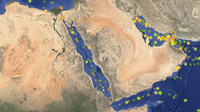
On Monday, the Houthis threatened to target Saudi exports, implying a potential resurgence of attacks on tankers at the Bab el Mandeb Strait and in the Red Sea.
Houthi threat and potential market impact
The Houthis announced a “maritime embargo” against Saudi Arabia on Monday. Maritime risk company Marisks warned that this should be treated “as credible escalation, not routine rhetoric”.
It is unclear whether all crude and products exports from Yanbu would be threatened or whether the maritime embargo just applies to Saudi tankers.
Marisks believes the most likely initial targets would be vessels owned, operated or controlled by Bahri or Saudi Aramco.
“At present, there is insufficient evidence to conclude that any foreign vessels trading with Saudi Arabia have become legitimate targets,” Marisks said, although it believes non-Saudi operators “should consider their exposure elevated”.
If the Houthis targeted very large crude carriers broadly, it could limit Saudi Arabia’s crude exports via the East-West pipeline to its Red Sea port of Yanbu, which bypass the Strait of Hormuz.
Prior to the Hormuz crisis, Yanbu exported an average of 763,229 barrels per day of crude and condensate, according to Vortexa data (from the week ending June 20, 2025 to the week ending March 1, 2026).
The majority of the pre-crisis volume — 78% — went north to Ain Sokhna, Egypt, the southern terminus of the SuMed pipeline, which brings crude to the Mediterranean for loading at Sidi Kerir, Egypt. Fully laden VLCCs cannot transit the Suez Canal.
Yanbu has exported an average of 3.75m bpd of crude and condensate since the Hormuz crisis began, according to Vortexa data (from the week ending March 8 to the week ending July 19).
That equates to incremental supply of 3m bpd, offsetting a portion of Saudi Arabia’s lost Middle East Gulf exports.
The majority of Yanbu crude exports since March — 62% — have gone to four Asian buyers: India, Japan, China and South Korea, with 23% continuing to flow via the SuMed.
If VLCCs loaded with Saudi crude were targeted in the Bab el Mandeb, it could push more flows toward the SuMed, and/or reduce Yanbu exports.
The SuMed option makes commercial sense for crude exports to west-of-Suez buyers, but it would lead to a potentially uneconomical circuit eastward around the Cape of Good Hope for cargoes to Asia.
Oil Brokerage Ltd estimated that if the entire Yanbu crude flow to Asia was rerouted around the Cape of Good Hope, it would increase VLCC and suezmax demand by 14%, requiring 70 additional VLCCs and 75 suezmaxes.
Yanbu crude exports bound for the SuMed surged last week, rising to 1.8m bpd, according to Vortexa data. That was up 66% versus the week before and almost triple flows two weeks before.
Last week’s crude volume to Egypt represented 46% of exports from Yanbu and marked the highest volume in that direction since the first week of the Hormuz crisis, before tankers repositioned to load crude for Asia delivery.
Yanbu is also a significant exporter of clean products. Clean exports have averaged 605,485 bpd (including liquefied petroleum gas) since the Hormuz crisis began, down 4% versus pre-crisis, according to Vortexa data.
The Houthi threat, if it transpires, could restrain Yanbu clean exports to east-of-Suez buyers, and shift more toward west-of-Suez buyers.
Since the week ending March 8, Yanbu clean exports to east-of-Suez destinations have averaged 364,552 bpd, accounting for 60% of the port’s clean exports, according to Vortexa data.
That is up 24% versus the pre-crisis period, when Yanbu clean exports to east-of-Suez destinations averaged 293,132 bpd, accounting for 46% of the total.
Reescalation of Hormuz crisis
The Houthi warning coincides with ongoing Iranian attacks on commercial ships in the Strait of Hormuz.
Dynacom’s product tanker Kavomaleas (IMO: 1042823) was stuck by missiles off the coast of Oman on Sunday. The crew abandoned ship; video posted online showed the tanker’s entire superstructure ablaze. According to UKMTO, the vessel is now adrift.
The Dynacom-owned VLCC Acheloos (IMO: 1087524) was also struck while transiting Hormuz on Sunday; all crew are reported safe and the vessel proceeded to an anchorage off Oman for a damage assessment.
UKMTO reported yet another attack on a tanker in the strait on Monday night; it said that the crew had taken to lifeboats and abandoned ship.
The reescalation of hostilities at the Strait of Hormuz over recent weeks has effectively brought the MEG tanker market back to its pre-June status.
“For VLCCs specifically, transits are down to an average of two VLCCs per day over the past week, from five daily VLCCs the previous week and the average of eight daily crossings seen in late June and early July,” Clarksons Securities said on Monday.
“Not surprisingly given the rise in uncertainty, VLCC spot activity was very slow last week with reported fixtures [in the MEG] the lowest since the first week of April,” said Clarksons.
According to Deutsche Bank shipping analyst Chris Robertson, “We fear that the targeting of civilian and energy infrastructure by both sides could create an escalation spiral, resulting in other transport and storage infrastructure or energy assets in the region being targeted.
“We believe the first-order impact of the current reescalation of hostilities on the tanker market will be the vast majority of owners opting to avoid trading in the region.
“Public tanker owners and operators that we have spoken to over the last several weeks continue to reiterate that they will avoid the Middle East in general and the Strait of Hormuz in particular,” said Robertson.
Crude tanker spot indexes
The Hormuz crisis remains a positive driver for VLCC spot rates globally as it ties up tonnage.
Signal Ocean reported on Monday that there were 123 VLCCs either inside the Strait of Hormuz or positioned outside. Clarksons puts the total on-the-water VLCC fleet at 925, implying that 13% of capacity is tied up by the Hormuz crisis.
VLCC rates in the Atlantic basin are still in lofty six-figures-per-day territory, although they are on the decline, verging on five figures.
The Baltic Exchange’s time-charter equivalent index for VLCCs on the US Gulf-China route came in at $104,662 per day on Monday, down 29% month on month (m/m).
The West Africa-China VLCC index was at $103,246 per day, down 41% m/m.
Sub-VLCC crude tanker segments have recently fared much better.
The Baltic’s suezmax index (an average of the Black Sea-Mediterranean and West Africa-North Europe indexes) is up 41% m/m, to $149,781 per day.
The Caribbean-US Gulf aframax index was at $60,143 per day on Monday, up 78% m/m. The US Gulf-Europe aframax index was at $70,475 per day on Monday, up 132% m/m.
The short-haul cross-Mediterranean aframaxes index remains the star performer. It was at $151,308 per day on Monday, doubling over the past week and up 198% m/m.
“It was was an amazing week for owners with extremely high levels of activity and rates shooting all the way up to Worldscale 430 on shorter Libya runs,” said brokerage BRS on Monday. “The list remains tight and if activity persists after the weekend, rates could firm further.”
Content Original Link:
" target="_blank">