











More Tankers Struck as IRGC Expands Threat Against Non-Compliant Vessels
The Iranian Revolutionary Guards Corps Navy issued a statement on Friday, taking credit for a series of recent attacks on tankers, saying it was increasing enforcement on non-compliant vessels and the range of strikes. This came as one new strike was confirmed, with several other incidents reported, and the International Maritime Organization showing that incidents related to the war have now passed the 100 mark.
Concern is rising in the shipping community as Iran has escalated the rate of attacks during October. Kpler is reporting that crude exports are “sharply lower” this week. As of October 7, it says the level is down by approximately a third to just under 10 million barrels per day versus around 15.5 million barrels per day in September.
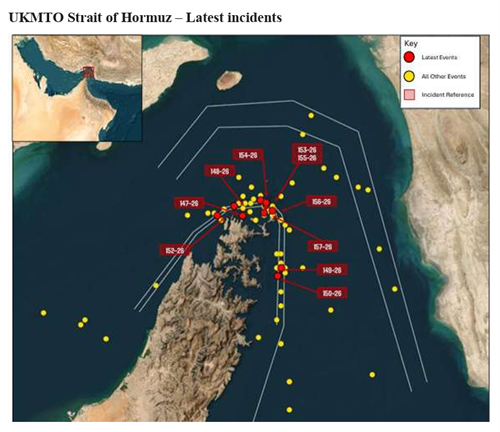
Increasing the fears is the confirmed report of a tanker struck while anchored off the UAE on Friday morning. UK Maritime Trade Operations said multiple sources placed the vessel 13 nautical miles west of Al Jazeera, with reports of a fire caused by the strike. It came just days after Iran struck another tanker off Qatar, the first strikes in the broader Gulf region in at least six weeks.
Several of the security consultancies are reporting today’s strike was on a Chinese-owned VLCC, Gem No. 2 (302,783 dwt), registered in Panama and operating under charter to Trafigura. The reports said the fire had been extinguished, but the level of damage is unclear.
The IRGC Navy did not take credit for this attack, but in its statement said “From now on, encounters with offending vessels will not be limited to the Strait of Hormuz, and any vessel that passes through an unauthorized passage anywhere in the region will be pursued and its punishment will be certain.”
UKMTO has reported 15 or 16 incidents believed to have taken place since September, with a dozen in recent days. Further, it reports that since July, there have been 59 incidents, of which 41 involved commercial shipping in the Strait of Hormuz. The IMO, in its listing, shows that confirmed incidents since the start of the war passed 100 with the strike on the tanker ST1 (IMO 9256999) off Oman on Wednesday.
AI data analysts Windward report it has identified a dozen vessels struck in the recent attacks, of which 11 were tankers, and they were all transiting the southern channel near Oman with their AIS transmissions switched off.
The reports from Iran are claiming the actual number is higher, with additional vessels electing to turn around when they were warned. Iranian media is saying the reports coming into UKMTO are delayed because the United States does not want that actual pace of strikes to be known.
Iranian media was reporting “several heavy explosions” early on Friday in the southern passage of the Strait of Hormuz, which have not been independently confirmed. The Iranian Fars News Agency is reporting that military leaders said it was likely caused by non-compliant tankers striking mines. U.S. Central Command, however, reiterates its statement that there are no mines in the shipping lane, that they have all been cleared, and that the lane is open.
The IRGC claimed it struck the Vietnamese-owned LPG tanker NV Sunshine (54,975 dwt) late on Thursday or early Friday. It said the vessel was making an illegal transit and was hit, causing a fire in its engine room and disabling it while off Qatar. The vessel’s AIS signal shows it anchored off Ras Laffan, Qatar.
Separately, security consultants Vanguard Tech reports another VLCC tanker, the Marshall Island-flagged Dhalkut (299,997 dwt), was harassed on Thursday. The report says there was shooting near the vessel, which was anchored off the coast of Fujairah in the UAE.

that matters most
Get the latest maritime news delivered to your inbox daily.
While these reports remain unconfirmed, they have created new jitters in the world oil markets. The benchmark Brent crude oil price, which was hovering around $100 per barrel, last week went to $102, and today is holding around $104.50 to close the week.
Iran is counting on this economic pressure as it attempts to regain its leverage over the Strait of Hormuz. It is also likely attempting to raise the pressure on the Trump administration as the U.S. midterm elections approach, while Donald Trump said yesterday he did not see resuming attacks on Iran before election day on November 3 in the United States.
Content Original Link:
" target="_blank">