












Iran offers to restore Hormuz shipping access amid push for US negotiations
Iran has offered to reopen the Strait of Hormuz within seven days if the United States takes initial steps to ease military pressure on Tehran, according to a senior Iranian government official.
The proposal, which has reportedly been conveyed to Washington through intermediaries, is part of Tehran’s renewed efforts to bring the United States back to negotiations and establish a lasting end to hostilities between the two countries.
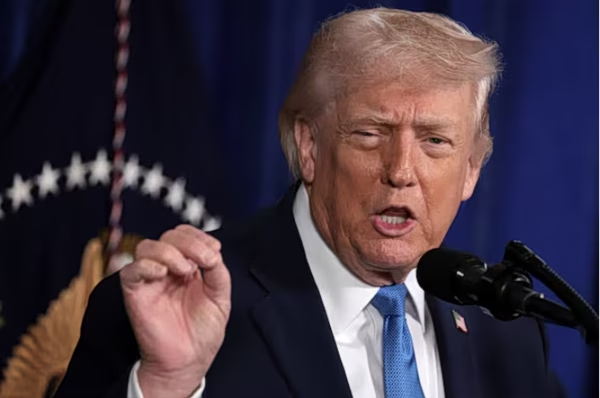
According to Kyodo news, the Iranian official said Tehran intends to use this week’s United Nations General Assembly in New York to consult with countries acting as intermediaries in the dispute. However, the official ruled out a meeting between Iranian President Masoud Pezeshkian and US President Donald Trump on the sidelines of the gathering.
Despite this, Tehran maintains that there is still scope for diplomatic progress, provided Washington demonstrates what the Iranian side described as sufficient “seriousness and commitment” to negotiations.
Strait of Hormuz at the centre of negotiations
According to the official, Iran is seeking evidence that the United States is prepared to return to talks and take steps toward ending what Tehran describes as a US military blockade of Iranian ports, as well as halting military operations linked to the Strait of Hormuz.
If Washington takes those initial measures, Iran would be prepared to reopen the strategic waterway within seven days and return to negotiations, the official said.
For the maritime industry, the proposal carries particular significance. The Strait of Hormuz is one of the world’s most important shipping chokepoints and a critical route for global energy transportation. Restrictions on vessel movements through the passage have already affected commercial traffic, with shipping activity remaining well below pre-conflict levels.
Iran’s renewed diplomatic push also comes as restrictions on its ports continue to place pressure on crude oil exports, a major source of national revenue.
The latest initiative has reportedly received approval from Supreme Leader Mojtaba Khamenei and the Supreme National Security Council, Iran’s highest security body.
Council Secretary Mohsen Rezaei said on 19 September that Tehran had presented Washington with seven conditions, including an end to restrictions on Iranian ports and the unfreezing of Iranian assets.
The Iranian official did not clarify whether the latest proposal represented a partial easing of those broader conditions.
Deadline adds further pressure
The diplomatic initiative comes as a separate deadline established by Iran’s Supreme National Security Council approaches. According to the official, the council decided on August 16 that Tehran would retain the option of launching another attack against US forces if Washington failed to lift the restrictions on Iranian ports within 45 days.
The current confrontation began in late February, when the United States and Israel launched attacks against Iran. A memorandum of understanding reached between Washington and Tehran in June subsequently collapsed amid renewed hostilities and unresolved disagreements.
Since then, the two sides have continued to exchange attacks intermittently, raising concerns over a broader escalation. At the same time, commercial shipping through the Strait of Hormuz remains significantly below pre-conflict levels.
For shipowners, operators and energy traders, any agreement that restores predictable access to the waterway could have immediate implications for voyage planning, vessel risk assessments, insurance and global energy supply chains. Until such an agreement is reached, however, the security situation around one of the world’s most critical maritime passages remains uncertain.
Content Original Link:
" target="_blank">