










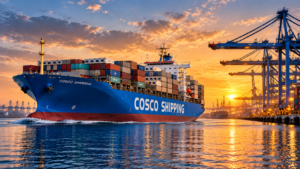
COSCO Shipping Ports: What is driving its overseas terminal growth?


COSCO Shipping Ports’ overseas terminal portfolio is outperforming its wider network in 2026, although the headline figures conceal significant differences between individual facilities.
According to the latest throughput figures reported by Container News, the company’s overseas terminals, excluding Container Terminal Tollerort (CTT), handled 31.48 million TEUs during January–September, an increase of 18.9% year on year.
This compares with 8.5% growth across the company’s reported monthly throughput portfolio, which reached 93.91 million TEUs over the same period. Overseas terminals also recorded a 20.7% increase in September alone.
The figures indicate that international operations are contributing significantly to the group’s expansion. However, strong gains at some facilities contrast with substantial declines elsewhere, making terminal-level performance essential to understanding the broader trend.
Suez leads in volume, Chancay in percentage growth
The company’s official monthly throughput statistics reveal sharply contrasting performances across its international portfolio.
| Terminal | Jan–Sep 2026 | YoY change |
|---|---|---|
| Suez Canal Container Terminal | 4.70 million TEUs | +17.3% |
| Piraeus Container Terminal | 3.09 million TEUs | +1.7% |
| Euromax Terminal Rotterdam | 1.66 million TEUs | −5.5% |
| CSP Abu Dhabi Terminal | 540,700 TEUs | −55.3% |
| CSP Chancay Terminal | 341,400 TEUs | +47.3% |
Source: COSCO Shipping Ports, monthly throughput statistics, September 2026.
Chancay recorded the fastest percentage growth among these facilities, with throughput increasing 47.3% during the nine-month period. However, its relatively small volume base limits its contribution to the portfolio’s overall expansion.
Suez presents a different picture. Its 17.3% growth was recorded on a much larger operational base, representing approximately 693,000 additional TEUs compared with the corresponding period of 2025.
By comparison, Chancay’s increase amounted to approximately 110,000 TEUs.
This distinction is important: percentage growth highlights momentum, while absolute volume changes provide a clearer indication of which terminals contribute most to overall expansion.
Piraeus recorded a comparatively modest 1.7% increase over nine months, despite stronger September growth of 15.3%. The latest monthly improvement is notable, but further data will be needed to determine whether it represents a sustained trend.
Abu Dhabi exposes the uneven performance
The most significant negative development among the selected facilities comes from CSP Abu Dhabi Terminal.
Throughput declined 55.3% to approximately 541,000 TEUs during January–September, compared with around 1.21 million TEUs in the corresponding period of 2025.
This represents a reduction of approximately 670,000 TEUs, almost equivalent to the additional volume recorded at Suez over the same period.
The decline is particularly relevant because it illustrates how individual terminals can move in sharply different directions despite strong overall portfolio growth.
In its first-half results, reported by Container News, COSCO Shipping Ports attributed Abu Dhabi’s weaker performance to geopolitical tensions in the Middle East.
The latest statistics show that the terminal’s cumulative decline deepened from 44.3% at the end of June to 55.3% by September.
Euromax Terminal Rotterdam also recorded weaker activity, with throughput falling 5.5% during the nine months.
These contrasting performances highlight the importance of assessing overseas expansion at the individual terminal level, rather than assuming that strong portfolio growth reflects consistent conditions across all markets.
Does higher throughput mean higher profitability?
The company’s financial results provide another perspective on its operational development.
According to COSCO Shipping Ports’ official 2026 interim results, revenue increased 12.3% to US$905.3 million during the first half of the year. Profit though, attributable to equity holders rose 28.5% to US$233.7 million.
Gross profit increased 9.3% to US$239.5 million, although the gross profit margin declined from approximately 27.2% to 26.5%.
The figures demonstrate why throughput growth and financial performance should be assessed separately.
COSCO Shipping Ports operates through a combination of controlling and non-controlling interests. Consequently, an increase in total containers handled does not necessarily translate proportionately into consolidated revenue or profit attributable to shareholders.
The first-half results also reported a 7% increase in equity throughput to 24.49 million TEUs.
However, these financial results cover January–June, whereas the latest terminal-level throughput statistics extend through September. They therefore cannot establish how much of the subsequent overseas growth has contributed to earnings.
There is also a reporting distinction between the company’s interim results and its monthly throughput statistics. The monthly dataset excludes QPI and CTT, resulting in a different reporting scope. Consequently, the two sets of aggregate throughput figures should not be combined when calculating quarterly changes.
What the figures reveal about COSCO’s international portfolio
The latest results show that overseas growth is neither uniform nor driven by a single terminal.
Suez contributes substantial additional volumes and Chancay continues expanding from a smaller base. Piraeus has recorded stronger recent monthly performance despite limited cumulative growth.
At the same time, Abu Dhabi and Euromax demonstrate that significant declines can occur within an otherwise expanding international portfolio.
For COSCO Shipping Ports, the commercial challenge is to convert this uneven operating performance into sustainable financial returns across terminals with different ownership structures, market conditions and growth prospects.
Subsequent financial disclosures will provide a clearer indication of whether stronger international throughput is translating into improved profitability.
COSCO’s overseas expansion is gaining momentum. But the more revealing measure is where additional containers are being handled, where volumes are being lost and how those differences affect the group’s financial performance.
The post COSCO Shipping Ports: What is driving its overseas terminal growth? appeared first on Container News.
Content Original Link:
" target="_blank">