











ZIM’s ZX3 enters a Transpacific premium race already shaped by speed and landside access


ZIM’s planned ZX3 service between China and Los Angeles adds another competitor to the premium Transpacific market. But the significance of the launch extends beyond the advertised 12-day crossing from Shanghai. It places ZIM in competition with carriers that have already built expedited shipping products around terminal operations, chassis availability and faster access to inland transport.
The new service, announced by ZIM, is scheduled to begin in December 2026. As Container News reported, ZX3 will connect Xiamen and Shanghai directly with Los Angeles, joining the carrier’s existing ZEX and ZX2 expedited services.
The competitive question is not whether ZIM can advertise a fast crossing. It is whether the new service can translate that speed into reliable cargo availability and efficient onward delivery in a market where rivals already offer comparable features.
Ocean transit is only part of the comparison
ZIM is advertising a 12-day Shanghai–Los Angeles transit and a 15-day connection from Xiamen. Both are scheduled service propositions rather than demonstrated operating results, as ZX3 has yet to begin.
The wider market provides useful context, although published transit figures require careful interpretation.
CMA CGM’s Eagle Express X (EXX) is marketed as an expedited Transpacific service linking Shanghai with Los Angeles. Its offering places emphasis on fast ocean transit and coordinated terminal operations, although advertised transit times should be distinguished from the carrier’s current sailing schedules and actual voyage performance.
Matson’s published CLX service information lists a 10-day Shanghai–Long Beach ocean transit, with cargo availability the following day. The destination is Long Beach rather than Los Angeles, making it relevant to competition across the Southern California gateway without representing an identical port-to-port comparison.
These distinctions matter because a carrier’s advertised crossing time does not necessarily reflect its current schedule, actual voyage performance or the time at which an importer can collect cargo.
Consequently, ZX3’s 12-day offering should be assessed as part of a competitive expedited product, not as evidence that ZIM will operate the fastest service in the market.
The terminal is becoming part of the product
The most revealing aspect of ZX3 is its destination-side operating model.
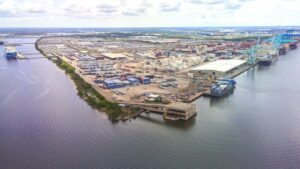
ZIM plans to use a dedicated berth at West Basin Container Terminal in Los Angeles, supported by a dedicated container yard, pickup lanes and chassis arrangements. The carrier also advertises Monday arrivals and expedited cargo availability without appointments or queues.
These features are commercially important because the benefit of a fast ocean crossing can be diminished by delays between vessel arrival, discharge and cargo collection.
Yet ZIM is not alone in offering such arrangements.
CMA CGM’s EXX product uses Fenix Marine Services in Los Angeles and advertises dedicated chassis, a container yard for expedited pickup and coordinated cargo handling. Its commercial proposition combines ocean speed with predictable terminal operations.
Matson similarly promotes dedicated terminal facilities at Long Beach, next-day cargo availability and an off-dock operation designed to facilitate faster truck collections.
The common feature is the integration of terminal access into the shipping product. Rather than treating discharge as the end of the ocean carrier’s competitive proposition, these services place greater emphasis on what happens immediately after the vessel arrives.
ZX3 therefore represents an expansion of ZIM’s participation in an established form of premium competition, rather than the introduction of an entirely new operating concept.
Inland connections extend the competitive field
The same pattern is visible in inland transport.
ZIM says ZX3 will provide expedited rail connections to destinations including Chicago, New York, Memphis, Dallas and Kansas City. This extends the service proposition beyond importers collecting containers in Southern California.
CMA CGM promotes its EXX RailFlash offering, including rail connections from Los Angeles to major inland markets. Matson also markets expedited intermodal services through its logistics operations.
For shippers, these arrangements can be as important as the ocean crossing itself. A container that arrives quickly at the West Coast but misses an inland connection may lose much of its time advantage.
However, the available announcements do not establish which carrier offers the fastest end-to-end transit to individual inland destinations. Such a comparison would require matching origin points, vessel schedules, discharge times, rail departures and cargo availability at the final destination.
It would also need to account for differences between advertised services and actual performance.
Without those measurements, no reliable ranking of ZX3, EXX and CLX/MAX can be established across the full supply chain.
What ZX3 adds to ZIM’s network
Beyond individual transit times, ZX3 expands the geographical coverage and frequency of ZIM’s expedited offering.
The company says the addition will bring its premium network, including ZEX and ZX2, to seven weekly departures from China and Vietnam to the US West Coast.
This is relevant because premium service competition also depends on sailing frequency and the availability of alternative departures. More weekly options may help customers manage shipment timing, although the number of departures does not by itself establish capacity, reliability or market share.
Xiamen is another important element. ZIM is positioning ZX3 as a dedicated premium offering for that origin, alongside an additional direct Shanghai connection.
The commercial significance will depend on how much cargo the service attracts, whether its schedules perform consistently and how effectively the terminal and inland arrangements operate after launch.
ZIM has not provided sufficient public operating data to quantify those outcomes.
The real test begins after launch
The competitive implications of ZX3 will become clearer once the service enters operation in December.
Several measures will matter: actual Shanghai and Xiamen transit times, consistency of Monday arrivals, the interval between berthing and cargo availability, and the performance of inland connections.
Those results will determine whether ZIM can deliver a commercially meaningful alternative to established expedited offerings.
For now, the launch demonstrates that premium Transpacific competition increasingly encompasses the full journey from Asian loading port to US cargo collection and inland distribution.
ZIM’s challenge is not simply to cross the Pacific quickly. It is to deliver the coordinated terminal and inland performance that customers increasingly expect from an expedited shipping product.
The post ZIM’s ZX3 enters a Transpacific premium race already shaped by speed and landside access appeared first on Container News.
Content Original Link:
" target="_blank">