











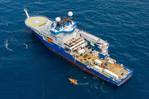
In the tropical Atlantic Ocean, scientists onboard Schmidt Ocean Institute’s R/V Falkor (too) have completed the most comprehensive survey in over two decades on an ocean physics phenomenon called salt finger mixing,
In the tropical Atlantic Ocean, scientists onboard Schmidt Ocean Institute’s R/V Falkor (too) have completed the most comprehensive survey in over two decades on an ocean physics phenomenon called salt finger mixing, which plays a critical role in ocean mixing but is extremely difficult to study.
Salt finger mixing occurs when warm, salty surface water sits atop cool, less salty water. The driving forces behind this phenomenon are diffusion and density. Heat makes water less dense, and salt makes it denser. Because heat diffuses through water 100 times faster than salt, the mixing waters form tiny alternating “fingers” of sinking and rising fluid.
Salt finger mixing is especially prominent in the tropical Atlantic because warm surface waters collide with cooler waters carried by deep-ocean currents. The scientists suspect this mixing carries critical nutrients to the surface, feeding phytoplankton in an otherwise nutrient-poor ecosystem.
 A Vertical Microstructure Profiler (VMP) 5500 sinks through the water column. The instrument profiles ocean mixing by descending through the water column to take centimeter-scale measurements before returning to the surface. © Alex Ingle / Schmidt Ocean Institute
“Measuring fine-scale ocean mixing is like measuring a whisper,” said Dr. Joseph Gradone, an assistant research professor at Rutgers
Content Original Link:
" target="_blank">